
Book review: Karl Bartos – The Sound of the Machine
Book review: Karl Bartos – The Sound of the Machine
There’s a fundamental friction that runs through the whole of Karl Bartos’ encyclopaedic autobiography, “The Sound of the Machine”.
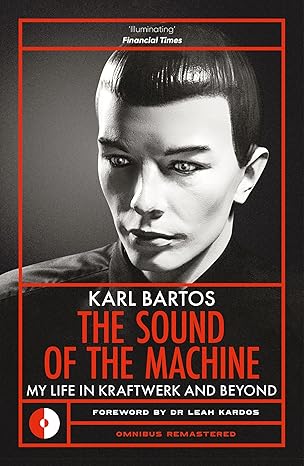
The cover features one of the austere portraits that typified Kraftwerk. Is it Karl or is it one of the several masks they used for promo and stage work?
In other words, how real is it?
Dusseldorf in the seventies
Bartos details everything in his book. So let’s skip to the meaty stuff quickly: in the seventies, he was happily running parallel careers as a classically-trained percussionist and member of beat bands in Dusseldorf.
Kraftwerk already existed at the time. Ralf Hütter and Florian Schneider were looking for a percussionist. Recommended by a professor, Bartos visited the Kling Klang studio and immediately gelled with the group. Through extensive jam sessions using often lo-fi instruments and (for the time) high tech, they grew the very particular Kraftwerk sound.
They also honed the KW schtick – the idea that all this emotional stuff is unnecessary. Songs could be about a motorway, neon lights, comets or radio waves. At the same time, they squeezed all emotion from the visuals.
They came across as pastiches of humanity. This is the birth of the robot/showroom dummy. Was there anyone there?
Deep intellectuals
Yet Kraftwerk were never just another pop band. Hütter and Bartos both had deep intellectual curiosity, which Bartos displays in his excellent musings about classical composers (if you have wondered what to make of classical music, this section will help).
Bartos emerged as perhaps the most musical of the team. For example, the drum patterns on many of the tracks are more subtle that one would expect.
Dynamics of Kraftwerk
What became increasingly clear to both Bartos and therefore the reader, is that the dynamics of the band were very particular. Bartos had to basically stamp his foot to get any recognition (or composing credits). The Hütter/Schneider duo ran Kraftwerk literally like a company.
At a certain point, this became an issue. Albums became harder and harder to finish, (Tour de France took an agonising five years). And for all the influence they have had on popular music, Kraftwerk never really had the success they aspired to.
Musical loop
It must also be said that they were on a musical loop, using familiar sounds and effects over and over.
The problem, according to Bartos, is that they had stopped actually playing or jamming together, and writing became a process of assembly rather than an organic one. There is a lesson here crying out to people that work on their own primarily with desktop tools. The irony is that this was what they had been claiming or at least projecting from the start.
The question here is: could Kraftwerk have become what it is without the contribution of a classically-trained musician and their improvisations at rehearsals? Given that he co-wrote many of the trademark songs, I’d argue that Bartos’ role was essential.
But life did not end when Bartos left Kraftwerk (check his website below). His various projects have continued largely in the same musical vein, albeit harmonically more rich. He also plays the Kraftwerk tracks that he co-wrote in concert with side projects (such as providing a live accompaniment to the silent movie “The Cabinet of Dr Caliagari”)..
Ultimately, “The Sound of the Machine” is a fascinating and detailed account of how one of the defining sounds of the age came about.
What we learn:
- The massive influence of avant-garde art and music from the twenties onwards
- How the trademark sound was forged
- The importance of jamming in their songwriting
- The evolution of recording and audio-visual technology
- The internal dynamics of a successful band (not unique to Kraftwerk)
- The fascinating musical path of Karl Bartos himself
At over 600 pages, “The Sound of the Machine” is a hefty book – and I’ve just realised that this is a hefty review. But it’s an easy read and is recommended.
(Michael Leahy. Photo: Omnibus Press)
Buy The Sound of the Machine on Amazon. Visit Karl Bartos’ official site